Showing posts with label research. Show all posts

Thursday, March 15, 2012

NSA partners with Google


DOJ Asks Court To Keep Secret Any PARTNERSHIP Between GOOGLE And NSA:


NSA

The Justice Department refuses to divulge whatever sort of agreement there may be between Google and the National Security Agency. Not that there is one, of course.
Mike Scarcella in The Legal Times writes about The Justice Department defending the government’s refusal to discuss, or acknowledge the existence of, “any cooperative research and development agreement between Google and the National Security Agency.”

 The Washington based advocacy group Electronic Privacy Information Center sued in federal district court here to obtain documents about any such agreement between the Internet search giant and the security agency.

The NSA responded to the suit with a so-called “Glomar” response in which the agency said it could neither confirm nor deny whether any responsive records exist. U.S. District Judge Richard Leon in Washington sided with the government last July.

Cultural stereotypes rooted in Genetic's

Why the British are freethinking and the Chinese love conformity: It's all in the genes claim scientists:


Gene DNA


Cultural stereotypes may be deeply rooted in our genetic makeup, say scientists.  Common traits like British individualism and Chinese conformity could be attributed to genetic differences between races according to a new study.  The study, by the department of psychology at Northwestern University in Illinois, suggests that the individualism seen in western nations, and the higher levels of collectivism and family loyalty found in Asian cultures, are caused by differences in the prevalence of particular genes. Common traits like British individualism and Chinese conformity could be attributed to genetic differences between races according to new research.  'We demonstrate for the first time a robust association between cultural values of individualism–collectivism and the serotonin transporter gene,' said Joan Chiao, from the department of psychology at Northwestern University.  Chiao and her colleagues combined data from global genetic surveys, looking at variations in the prevalence of various genes. The findings were matched with other research which ranked nations by levels of individualism and collectivism.  The team focused their attentions on the gene that controls levels of serotonin, a chemical in the brain which regulates mood and emotions.

All together now: Japanese men praying

Japanese men praying.  Their studies found that one version of the gene was far more common in western populations which, they said, was associated with individualistic and freethinking behavior.  Another version of the same gene, which was prevalent in Asian populations, they said was associated with collectivism and a greater willingness to put the common good first.  People with this gene appeared to have a different response to serotonin.


Free-thinking: A protestor at the Occupy site in front of St Paul's in London A protestor at the Occupy site in front of St Paul's in London.  If they are confirmed, the findings made by Chiao and her colleagues would suggest that races may have a number of inherent psychological differences — just as they differ in physical appearances.  Chiao suggests that the version of the gene predominating in Asian populations is associated with heightened anxiety levels and increased risk of depression.  She adds that such populations respond by structuring their society to ward off those negative effects.  The success of such social structures would then ensure that the gene would spread.  She added the findings showed how culture could exert a powerful influence on human genetics and evolution.


10,000 Year old Mammoth

Russia Plans to Clone 10,000-Year-Old Woolly Mammoth:

Mammoth_skeleton
Russian scientists and a South Korean colleague will attempt to clone a woolly mammoth from a specimen frozen in the Siberian tundra for 10,000 years, RIA Novosti reported.  The Institute of Applied Ecology in Siberia’s Yakutsk region plan to implant genetic material from the mammoth into an egg of a live female elephant, the state-run Russian news service said.  The elephant will carry the fetus for 22 months and “hopefully give birth to a live baby mammoth,” RIA cited an unidentified official from the institute as saying.

Google's Semantic Search Technology


Google plans major overhaul to search engine:


Search-Google

Google is giving its tried-and-true web-search formula a makeover as it tries to fix the shortcomings of today's technology and maintain its dominant market share.  Over the next few months, Google's search engine will begin spitting out more than a list of blue web links. It will also present more facts and direct answers to queries at the top of the search-results page.  The changes to search are among the biggest in the company's history and could affect millions of websites that rely on Google's current page-ranking results. At the same time, they could give Google more ways to serve up advertisements.  Google isn't replacing its current keyword-search system, which determines the importance of a website based on the words it contains, how often other sites link to it, and dozens of other measures. Rather, the company is aiming to provide more relevant results by incorporating technology called "semantic search," which refers to the process of understanding the actual meaning of words.  Amit Singhal, a top Google search executive, said in a recent interview that the search engine will better match search queries with a database containing hundreds of millions of "entities" -- people, places and things -- which the company has quietly amassed in the past two years. Semantic search can help associate different words with one another, such as a company (Google) with its founders (Larry Page and Sergey Brin).  Google search will look more like "how humans understand the world," Singhal said, noting that for many searches today, "we cross our fingers and hope there's a web page out there with the answer." Some major changes will show up in the coming months, people familiar with the initiative said, but Singhal said Google is undergoing a years-long process to enter the "next generation of search."  Under the shift, people who search for "Lake Tahoe" will see key "attributes" that the search engine knows about the lake, such as its location, altitude, average temperature or salt content. In contrast, those who search for "Lake Tahoe" today would get only links to the lake's visitor bureau website, its dedicated page on Wikipedia.com, and a link to a relevant map.  For a more complex question such as, "What are the 10 largest lakes in California?" Google might provide the answer instead of just links to other sites.  The coming shift has major implications for Google, which dominates the Internet search market with around 66 percent market share and more than 75 percent of all search-ad revenue. The Mountain View, Calif., companies has succeeded because of the strength and ease of its keyword-search technology, which in turn fueled Google's search ads, which appear next to search results. That business now generates the majority of Google's $37 billion in annual revenue.  Now Google is taking action to maintain that lead. The Internet giant is trying to stay ahead of Microsoft's Bing in web search, catch up to Apple's Siri voice-activated mobile search, and beat back rivals in niches such as product search.


Monday, March 12, 2012

0.3mm Organic Battery

NEC develops 0.3mm thick organic battery:

[caption id="attachment_2337" align="aligncenter" width="1024" caption="Organic Battery"]Organic Battery

Organic batteries are an exciting area of research at the moment due to the benefits and potential they have to power our gadgets in the future. One of the companies at the forefront of organic battery development is NEC, which has been working on these polymer-based batteries since 2001 and had its first major release in 2005.  Organic batteries are desirable because they have a very high energy density considering their size, use no heavy metals, and are incredibly thin. That last feature is highlighted by NEC’s latest breakthrough, which has seen the creation of a 0.3mm thick organic radical battery.  Such a thin battery can be placed inside objects that are already very limited in thickness, for example, a sheet of e-paper, and of course a smart card or credit card. Until now the thickness was limited to 0.7mm, but NEC managed to cut that by over 50% all thanks to printed components.  The prototype battery was created by printing an integrated circuit and battery directly on to a polymer film. Such components allowed for a complete system to be built including a display, antenna, and encryption system. All of which sounds like the perfect solution for next-generation smart cards.  As for the power on offer from this super-thin battery, output is rated as 5kW/L with a capacity of 3mAh. In real terms that means the integrated display can be refreshed 2,000x, or the antenna can be used to transmit data 35x before a recharge is required. The recharge only takes around 30 seconds to top up the battery fully, and the capacity is only reduced by 25% after 500 charges.

Saturday, March 10, 2012

Immortality found in nature

"Immortal" Jellyfish Swarm World's Oceans:

Jellyfish
A potentially "immortal" jellyfish species that can age backward—the Benjamin Button of the deep—is silently invading the world's oceans, swarm by swarm, a recent study says.  Like the Brad Pitt movie character, the immortal jellyfish transforms from an adult back into a baby, but with an added bonus: Unlike Benjamin Button, the jellyfish can do it over and over again—though apparently only as an emergency measure.

About as wide as a human pinky nail when fully grown, the immortal jellyfish (scientific name: Turritopsis dohrnii) was discovered in the Mediterranean Sea in 1883. But its unique ability was not discovered until the 1990s.  How the Jellyfish Becomes "Immortal".  Turritopsis typically reproduces the old-fashioned way, by the meeting of free-floating sperm and eggs. And most of the time they die the old-fashioned way too.  But when starvation, physical damage, or other crises arise, "instead of sure death, [Turritopsis] transforms all of its existing cells into a younger state," said study author Maria Pia Miglietta, a researcher at Pennsylvania State University.  The jellyfish turns itself into a bloblike cyst, which then develops into a polyp colony, essentially the first stage in jellyfish life.  The jellyfish's cells are often completely transformed in the process. Muscle cells can become nerve cells or even sperm or eggs.  Through asexual reproduction, the resulting polyp colony can spawn hundreds of genetically identical jellyfish—near perfect copies of the original adult.  This unique approach to hardship may be helping Turritopsis swarms spread throughout the world's oceans.

Friday, March 2, 2012

Stonehenge found underneath lake

Stonehenge found in lake Michigan , experts say they need more research:


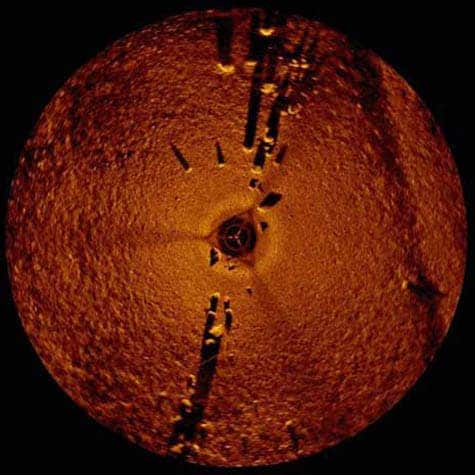
While scanning underneath the waters of Lake Michigan for shipwrecks, archeologists found something a lot more interesting than they bargained for, as they discovered a boulder with a prehistoric carving of a mastodon,  as well as a series of stones arranged in a Stonehenge-like manner.  At a  depth of about 40 feet into Lake Michigan’s Grand Traverse Bay, using sonar techniques to look for shipwrecks, archeologists discovered sunken boats and cars and even a Civil War-era pier, but among all these they found this prehistoric surprise, which a trained eye can guess by looking at the sonar scans photos in this article.


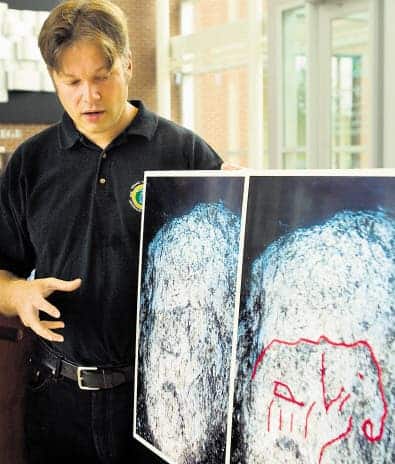
“When you see it in the water, you’re tempted to say this is absolutely real,” said Mark Holley, a professor of underwater archaeology at Northwestern Michigan University College who made the discovery, during a news conference with photos of the boulder on display in 2007. “But that’s what we need the experts to come in and verify.


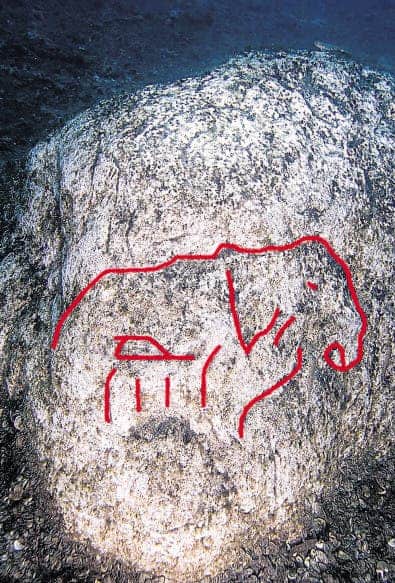
The boulder with the markings is 3.5 to 4 feet high and about 5 feet long. Photos show a surface with numerous fissures. Some may be natural while others appear of human origin, but those forming what could be the petroglyph stood out, Holley said.  Viewed together, they suggest the outlines of a mastodon-like back, hump, head, trunk, tusk, triangular shaped ear and parts of legs, he said.  “We couldn’t believe what we were looking at,” said Greg MacMaster, president of the underwater preserve council.  Specialists shown pictures of the boulder holding the mastodon markings have asked for more evidence before confirming the markings are an ancient petroglyph, said Holley.
“They want to actually see it,” he said. Unfortunately, he added, “Experts in petroglyphs generally don’t dive, so we’re running into a little bit of a stumbling block there.”

If found to be true, the wannabe petroglyph could be as much as 10,000 years old – coincident with the post-Ice Age presence of both humans and mastodons in the upper midwest. The formation, if authenticated, wouldn’t be completely out of place. Stone circles and other petroglyph sites are located in the area.  The discovery was made back a few years ago, and surprisingly enough the find hasn’t been popularized at all, with little to no information available online, but I’ll be sure to update this post as soon as I can get ahold of more info. So, who’s from Michigan?