Friday, March 2, 2012

Hitler had crashed UFO 1937

Hitler's Roswell: Alien saucer crash in 1937 Nazi Germany:
hitler-ufo

Ten years before an alien craft crashed onto rancher Mack Brazel's property near Roswell, New Mexico, a flying saucer lost control and crashed onto the countryside of Nazi Germany. This incredible story—covered-up by both the U.S. and U.S.S.R. for more than 70 years—is allegedly the actual basis for the Nazi's intense research into wingless, disc aircraft; Hitler's and Himmler's near obsession with exotic technology and flying saucers; and the incredible experiments by S.S. physicists that culminated with flying saucers and the 'Bell'—a bizarre multi-dimensional motor that neutralized gravity and ripped a gash into the very fabric of the time-space continuum creating incredible and horrific effects.  The Third Reich's saucer.  In 1937, as Nazi Germany was rising from the ashes of the old German Republic and becoming the world's first real superpower, an incredible thing happened: aliens crashed their distressed craft into the German countryside. The German army was there to pick up the pieces. No record exists, however, indicating whether any bodies were also retrieved.  When word of the crashed disc made ir's way back to the German High Command and the report landed on the Führer's desk, he immediately ordered elements of the Luftwaffe and Germany's top aeronautical experts to sift through the remains. Ostensibly, the damaged saucer was moved into a warehouse facility under 24-hour guard near the Rhine. Some parts were also flown to a facility near the Austrian border.  Allegedly, members of the teams that worked on the advanced alien technology were from the Luftwaffe, the Speer Ministry of Arms headed by Albert Speer, and the formal research council, the "Reichsforschungrat," composed of university professors and industrial engineers.  The teams were assembled to reverse engineer what was salvaged and among the experts called upon were the Horton brotherswho later designed and tested revolutionary flying wing aircraft and the world's first stealth jet fighter-bomber. Some of their resulting technology may have been gleaned from intense study of the alien craft, although that cannot be proven.  Later, the expertise of Viktor Schauberger was tapped. He was the inventor of the revolutionary imploder motor that created an imploding vortex.


Nazi experiment with anti-gravity device, the Glocke.  That motor may have been the basis for later S.S. experiments in Poland with the notorious Glocke (Bell) device that reportedly created inter-dimensional rifts in space-time.   Italian researcher Renato Vesco, in his classic and well-researched book,  asserts that the Nazis were working on many advanced propulsion systems and rudimentary anti-gravity devices to power their disc-shaped, or lenticular, aircraft.  Alien craft spurred German's engineering efforts.  Although vastly influenced by the capture of an actual disc, research into circular aircraft had been going on as far back as the experiments in Italy before 1920 with crude jets attached to aerodynamic discs. The ET craft served to advance propulsion, electronics and provided clues to workable designs, but the scientists were at a loss regarding the metallurgy as the craft was composed of materials unknown to them and impossible to duplicate in the lab.  Some of Germany's most advanced theoretical engineers and physicists were personally tasked by Hitler to get the technology working and make it available for the war effort. In that regards, geniuses like Ballenzo, Habermohl, Miethe and Schriever were recruited.  Documents captured by the Allies after the war ended indicate that Schriever was the first to have some success with the disc technology. His own research, augmented by what had by then been deduced from the retrieved saucer, enabled him to build a working craft powered by specially designed jet engines. The craft, however, was unstable. The first two versions ended in disasterous crashes killing the test pilots.  Tides of war turn, Nazis expand saucer projects.  As the years advanced and the Allies began counter-attacking Germany, some Nazi officials began pressuring Schauberger to adapt a verson of his Repulsine imploder to serve as the motive force for a different type of disc craft using the vortex propulsion motor.  Although the Nazi engineers and scientists built their first experimental saucers from light steel or heavy aluminum, the steel still proved too heavy and the aluminum too soft and not tough enough to withstand the stress subjected to it when molded into a lens-shaped craft.  Frustrated scientists finally gave up trying to unravel the mystery of the alien metal and succeeded in creating their own version with an alloy of aluminum and magnesium in 1944. The new alloy was exactly what they needed to design bigger and better craft. The metal was light, yet more durable than simple aluminum.  Primitive experimental propeller-driven disc airplane never saw production.  Hitler pressed the engineers onwards with greater frenzy. Germany was now suffering nightly bombing raids and factories across the country had been moved to gigantic underground facilities. Aircraft production lines were being hampered and destroyed and the rocket facility run by Werner von Braun at Peenemünde was not back up to full capacity after being bombed in 1943.  Slave laborers, mostly Slavic, were pressed into service to produce V-2 rockets, advanced aircraft, synthetic fuel, high explosives...and incredible remote-controlled flying saucers.


Nazi Kugelblitz attack Allied bombers over Germany.  The astounding Nazi Kugelblitz.  According to documents and the testimony of surviving Polish slave laborers, the Germans actually created an assemblyline to manufacture a flying disc weapon called the Kugelblitz (ball lightening).  The Allied pilots called them Foo-fighters.  The Kugelblitz was the first real flying saucer ever manufactured by any nation on Earth. Several of the tests were secretly attended by Hitler and his S.S. chief, Heinrich Himmler.  According to captured documents, the radio-controlled craft were made in the underground factories at Thuringia and the craft varied in size from 10 to 15-feet across. Reportedly they were amazingly manueverable and were able to achieve speeds of more than 1,250 miles per hour. They emitted a strong electo-static field designed to disrupt the electrical circuits of conventional aircraft causing enemy planes to falter, dive, and crash.  Other saucers.  Prototypes of other saucers were designed and engineering mock-ups were made. Some made it as far as wind tunnel tests. A few disc craft other than Schriever's early attempts were constructed and flown.  About 18 months before the Germans surrendered, Hitler pinned his hopesand those of Germanyon the incredible potential of a mind-boggling array of superweapons. The greatest of the weapons were his new class of Vengeance weapons.


Germany's planned hypersonic cruise missile V-3.  The old V-weapons were the rocket plane V-1 and intracontinental missile V-2. Hitler's dream envisioned the world's first cruise missile: a V-3 sub-orbital, intercontinental hypersonic rocket capable of hitting New York and Washington.  And then there were the flying saucersS.S. Reichsführer Himmler recommended S. S. Grupenführer Hans Kammler to head the saucer projects and save the Fatherland. Hitler agreed.  Later Kammler is said to have overseen the Glocke project as well.  Undoubtedly, Germany's superweaponsspecifically those they were perfecting in the closing months of the warwould have defeated the Allies and helped Germany conquer and rule Western and Eastern Europe, suppress the U.S.S.R., and keep America neuteredeven with the new atomic weapon the U.S. had developed.  But the Germans ran out of time.Some argue that no matter what the Nazis had, they could not have staved off American atomic attacks. Yet evidence exists that in the final weeks of the war the Germans successfully detonated their own low-yield atomic bomb and that coupled with stealth aircraft, the imploder vortex motor, advanced television bombs, the hypersonic V-3 "Amerika Bomb," and flying saucer fighters—ostensibly augmented with harvested alien technology—would have sealed the fate of the Nazi's enemies.  Perhaps Adolf Hitler would have attained his twisted dream of a Thousand Year Reich.

U.S. diplomats work directly for Monsanto

Leaked documents reveal US diplomats actually work for Monsanto:


Monsanto's


Biotech giant Monsanto has been genetically modifying the world's food supply and subsequently breeding environmental devastation for years, but leaked documents now reveal that Monsanto has also deeply infiltrated the United States government. With leaked reports revealing how U.S. diplomats are actually working for Monsanto to push their agenda along with other key government officials, Monsanto's grasp on international politics has never been clearer.  Amazingly, the information reveals that the massive corporation is also intensely involved in the passing and regulations concerning the very GM ingredients they are responsible for. In fact, the information released by WikiLeaks reveals just how much power Monsanto has thanks to key positions within the United States government and elsewhere. Not only was it exposed that the U.S. is threatening nations who oppose Monsanto with military-style trade wars, but that many U.S. diplomats actually work directly for Monsanto.  What the leaked documents reveal -- Military style trade wars, government corruption.  In 2007 it was requested that specific nations in the European Union be punished for not supporting the expansion of Monsanto's GMO crops. The request for such measures to be taken was made by Craig Stapleton, the United States ambassador to France and partner to George W. Bush. Despite mounting evidence linking Monsanto's GM corn to organ damage and environmental devastation, the ambassador plainly calls for 'target retaliation' against those not supporting the GM crop. In the leaked documents, Stapleton states:  "Country team Paris recommends that we calibrate a target retaliation list that causes some pain across the EU since this is a collective responsibility, but that also focuses in part on the worst culprits. The list should be measured rather than vicious and must be sustainable over the long term, since we should not expect an early victory. Moving to retaliation will make clear that the current path has real costs to EU interests and could help strengthen European pro-biotech voices."  The undying support of key players within the U.S. towards Monsanto is undeniably made clear not only in this release, but in the legislative decisions taken by organizations such as the FDA and USDA. Legislative decisions such as allowing Monsanto's synthetic hormone Posilac (rBGH) to be injected into U.S. cows despite being banned in 27 countries. How did Monsanto pull this off?  The Biotech juggernaut managed to infiltrate the FDA positions responsible for the approval of rBGH, going as far as instating the company's own Margaret Miller as Deputy Director of Human Safety and Consultative Services. After assuming this position, Miller reviewed her own report on the safety and effectiveness of rBGH.  Many US diplomats pawns of Monsanto's GM agenda.  While it may be shocking to you if you are not familiar with the corrupt influence of Monsanto, the cables also show that many US diplomats are pushing GMO crops as a strategic government and commercial imperative. Interestingly enough, the U.S. focused their efforts toward advisers to the pope specifically, due to the fact that many Catholic figureheads have openly voiced their opposition to GM foods. With this kind of political influence, is it any wonder that many food staples are now predominantly GM? Nearly 93% of U.S. soybeans are heavily modified conservatively, with many other staple crops coming in at similar numbers.  U.S. diplomats have unique opportunities to spread honest and intellectual campaigns that can serve to better mankind and end suffering, however they are instead spreading the roots of Monsanto deeper and deeper into international territory. As a substitute for the betterment of mankind, these paid-off diplomats are now spreading environment desecration and health destruction.  As if there wasn't already enough information to reveal Monsanto's corruption, the biotech giant also spends enormous amount of money lobbying government each year. Monsanto spent an astonishing $2 million lobbying the federal government in the 3rd quarter of 2011 alone, according to mainstream sources. Why so much cash? The government lobbying focuses on issues like regulations for GM crops and patent reforms. This 'legal' form of persuasion is the reason government agencies like the USDA and FDA let Monsanto roam freely.  Satisfying government officials' financial vested interest is all that matters when dealing with corrupt mega-corporations like Monsanto. As long as these financial ties continue to exist, Monsanto will continue to reign over the food supply and continue to wreak devastation to the environment, ecosystem, and humankind.

Stonehenge found underneath lake

Stonehenge found in lake Michigan , experts say they need more research:


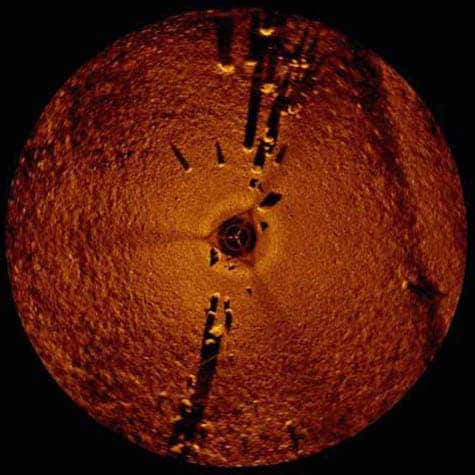
While scanning underneath the waters of Lake Michigan for shipwrecks, archeologists found something a lot more interesting than they bargained for, as they discovered a boulder with a prehistoric carving of a mastodon,  as well as a series of stones arranged in a Stonehenge-like manner.  At a  depth of about 40 feet into Lake Michigan’s Grand Traverse Bay, using sonar techniques to look for shipwrecks, archeologists discovered sunken boats and cars and even a Civil War-era pier, but among all these they found this prehistoric surprise, which a trained eye can guess by looking at the sonar scans photos in this article.


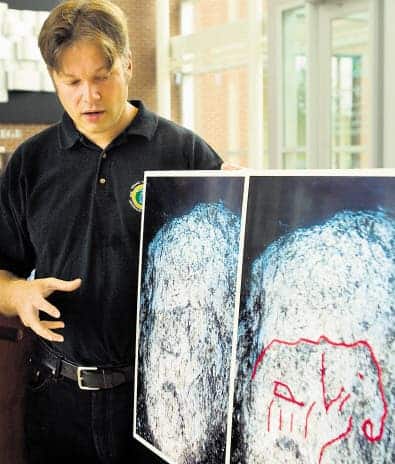
“When you see it in the water, you’re tempted to say this is absolutely real,” said Mark Holley, a professor of underwater archaeology at Northwestern Michigan University College who made the discovery, during a news conference with photos of the boulder on display in 2007. “But that’s what we need the experts to come in and verify.


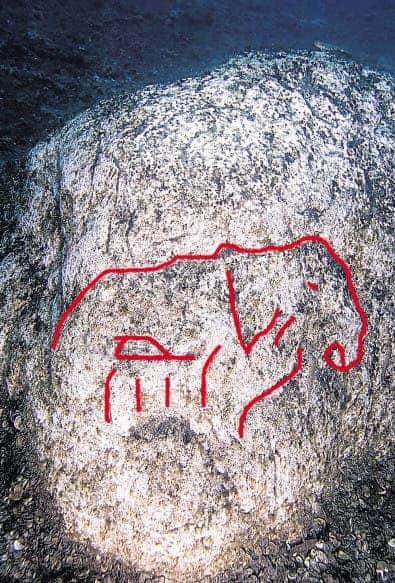
The boulder with the markings is 3.5 to 4 feet high and about 5 feet long. Photos show a surface with numerous fissures. Some may be natural while others appear of human origin, but those forming what could be the petroglyph stood out, Holley said.  Viewed together, they suggest the outlines of a mastodon-like back, hump, head, trunk, tusk, triangular shaped ear and parts of legs, he said.  “We couldn’t believe what we were looking at,” said Greg MacMaster, president of the underwater preserve council.  Specialists shown pictures of the boulder holding the mastodon markings have asked for more evidence before confirming the markings are an ancient petroglyph, said Holley.
“They want to actually see it,” he said. Unfortunately, he added, “Experts in petroglyphs generally don’t dive, so we’re running into a little bit of a stumbling block there.”

If found to be true, the wannabe petroglyph could be as much as 10,000 years old – coincident with the post-Ice Age presence of both humans and mastodons in the upper midwest. The formation, if authenticated, wouldn’t be completely out of place. Stone circles and other petroglyph sites are located in the area.  The discovery was made back a few years ago, and surprisingly enough the find hasn’t been popularized at all, with little to no information available online, but I’ll be sure to update this post as soon as I can get ahold of more info. So, who’s from Michigan?

Tuesday, February 28, 2012

Greed an American Virtue

 "The upper 1 percent of Americans are now taking in nearly a quarter of the nation's income every year. In terms of wealth rather than income, the top 1 percent control 40 percent:
One Percent takes half


In a piece by Joseph E. Stiglitz in the new issue of Vanity Fair. These facts confirm my impression that greed is now seen as a virtue in America. I'm not surprised by the greed of the One-Percenters. I'm mystified by the lack of indignation from so many of the rest of us.  Day after day I read stories that make me angry. Wanton consumption is glorified. Corruption is rewarded. Ordinary people see their real income dropping, their houses sold out from under them, their pensions plundered, their unions legislated against, their health care still under attack. Yes, people in Wisconsin and Ohio have risen up to protest these realities, but why has there not been more outrage?  The most visible centers of these crimes against the population are Wall Street and the financial industry in general. Although there are still many honest bankers, some seem to regard banking and trading as a license to steal. Outrageous acts are committed and go unpunished. Consider this case of money laundering by Wachovia Bank, now part of Wells Fargo. This Guardian article reports: "The authorities uncovered billions of dollars in wire transfers, traveler's checks and cash shipments through Mexican exchanges into Wachovia accounts."  The bank paid fines of less than 2% of its $12.2 billion profit in 2009. No individual was ever charged with a crime. We need not doubt that Wachovia executives received bonuses over the period of time when they were overseeing these illegal activities. Permit me to quote one more paragraph:  "More shocking, and more important, the bank was sanctioned for failing to apply the proper anti-laundering strictures to the transfer of $378.4 billion -- a sum equivalent to one-third of Mexico's gross national product -- into dollar accounts from so-called casas de cambio (CDCs) in Mexico, currency exchange houses with which the bank did business."  If a third of the Mexican GNP passes through your bank and you don't ask the questions required by law, you are either (1) a criminal, or (2) incompetent. I can't think of another possibility.  Stories like this have become commonplace. Two of the most common types of news stories about banks recently have involved their losses, and the size of their executive bonuses. Bloomberg News reports: "JPMorgan Chase & Co. gave Chief Executive Officer Jamie Dimon a 51 percent raise in 2010 as the bank resumed paying cash bonuses following two years of pressure from regulators and lawmakers to curb compensation."  And here's more, from the Wall Street journal: "$57,031. That's about what the average U.S. archaeologist made last year. It's also what J.P. Morgan CEO Jamie Dimon made every day of last year -- $20.8 million total, according to the firm's proxy filing this week. Anyone who has doubts about the resiliency of Wall Street banks and brokerages should ponder that figure for awhile. The J.P. Morgan board also spent about $421,500 to sell Dimon's Chicago home. And they brought back the big cash bonus, doling out $30.2 million in greenbacks to Dimon and his top six lieutenants."  The CEOs of the venerable trading firms that were forced into bankruptcy were all paid bonuses. In a small recent case, executives of Borders intended to pay themselves $8 million in bonuses until a U. S. Trustee objected. A company spokesperson said, "The proposed programs were designed to retain key executives at Borders as we proceed through the Chapter 11 reorganization process." In short, retain those whose management bankrupted the corporation.  Corporations in theory are managed to benefit their shareholders. The more money Wal-Mart can make by busting unions and allegedly discriminating in its hiring practices, the happier its shareholders become. Yet obscene bonuses penalize even the shareholders. Isn't that, in theory, their money? Wouldn't it be decent for the occasional corporation to put a cap on bonuses and distribute the funds as dividends?  I have no objection to financial success. I've had a lot of it myself. All of my income came from paychecks from jobs I held and books I published. I have the quaint idea that wealth should be obtained by legal and conventional means--by working, in other words--and not through the manipulation of financial scams. You're familiar with the ways bad mortgages were urged upon people who couldn't afford them, by banks who didn't care that the loans were bad. The banks made the loans and turned a profit by selling them to investors while at the same time betting against them on their own account. While Wall Street was knowingly trading the worthless paper that led to the financial collapse of 2008, executives were being paid huge bonuses.  Wasn't that fraud? Wasn't it theft? The largest financial crime in American history took place and resulted in no criminal charges. Then the money industries and their lobbyists fought tooth and nail against financial regulation. The Republicans resisted it, but so did many Democrats. Partially because of the Supreme Court decision allowing secret campaign contributions, our political system is largely financed by vested interests.  We know that Bernie Madoff went to jail. Fine. No Wall Street or bank executive has been charged with anything. It will never happen. The financial industries are locked an unholy alliance with politicians and regulators, all choreographed by lobbyists. You know all that.  What puzzles me is why there isn't more indignation. The Tea Party is the most indignant domestic political movement since Norman Thomas's Socialist Party, but its wrath is turned in the wrong direction. It favors policies that are favorable to corporations and unfavorable to individuals. Its opposition to Obamacare is a textbook example. Insurance companies and the health care industry finance a "populist" movement that is manipulated to oppose its own interests. The billionaire Koch brothers payroll right wing front organizations that oppose labor unions and financial reform. The patriots wave their flags and don't realize they're being duped.  Consider taxes. Do you know we could eliminate half the predicted shortfall in the national budget by simply failing to renew the Bush tax cuts? Do you know that if corporations were taxed at a fair rate, much of the rest could be found? General Electric recently reported it paid no current taxes. Why do you think that was? Why do middle and lower class Tea Party members not understand that they bear an unfair burden of taxes that should be more fairly distributed? Why do they support those who campaign against unions and a higher minimum wage? What do they think is in it for them?  If it is "socialist" to believe in a more equal distribution of income, what is the word for the system we now live under? A system under which the very rich have doubled their share of the nation's income in 25 years? I believe in a fair day's work for a fair day's pay. Isn't that an American credo? How did it get twisted around into an obscene wage for shameless plunder?  One of the challenges facing the One-Percenters these days is finding ways to spend their money. Private residences grow as large as hotels, and are fitted out with the amenities of luxury resorts. Fleets of cars and private airplanes are at their owners' disposal. At work, they sink absurd mountains of money into show-off corporate headquarters that have less to do with work than with a pissing contest among rival executives. Private toilets grow as large as small condos, outfitted with Italian marbles and rare antiques. This is all paid for by the shareholders. One area of equality between the One-Percenters and the rest of us is that we sit on toilets of about the same size. What's different is the size of our throne rooms.  I find this extravagance unseemly in a democracy. Many of today's One-Percenters feel no more constraint than Louis XIV. A culture of celebrity has grown up around these conspicuous consumers, celebrating their excesses. I believe rewards are appropriate for those who have been successful. I also believe a certain modesty and humility are virtuous. I find it unbecoming that those who fight most against social welfare are those most devoted to their own welfare.  In America there is an ingrained populist suspicion of fats cats and robber barons. This feeling rises up from time to time. Theodore Roosevelt, who was elected as a Trust Buster, would be appalled by the excesses of our current economy. Many of the rich have a conscience. Andrew Carnegie built libraries all over America. The Rockefeller and Ford Foundations do great good. Bill Gates lists his occupation as "philanthropist."  Yet the most visible plutocrat in America is Donald Trump, a man who has made a fetish of his power. What kind of sick mind conceives of a television show built on suspense about which "contestant" he will "fire" next? What sort of masochism builds his viewership? Sadly, it is based on viewers who identify with Trump, and envy his power over his victims. Don't viewers understand they are the ones being fired in today's America?

Upper class society lie and cheat

Members of the upper classes are more likely to lie, cheat and even break the law than people from less privileged backgrounds, a study has found:

rich-poor


In contrast, members of the "lower" classes appeared more likely to display the traditional attributes of a gentleman.  It suggests that the traditional notion of the upper class “cad” or “bounder” could have a scientific basis.  But psychologists at the University of California in Berkeley, who carried out the study, also suggested that the findings could help explain the origins of the banking crisis – with self-confident, wealthy bankers more likely to indulge in reckless behaviour.  The team lead by Dr Paul Piff, asked several groups of people from different social backgrounds to perform a series of tasks designed to identify different traits such as honesty and consideration for others.  Each person was asked a series of questions about their wealth, schooling, social background, religious persuasions and attitudes to money in an attempt to put them into different classes. The tasks included asking participants to pretend to be an employers conducting a job interview to test whether they would lie or sidestep awkward facts in pay negotiation. They were told that the job might become redundant within six months but were encouraged conceal this from the interview candidate.  There was also an online game involving rolling dice in which participants they were asked to report their own score, thinking they would be in line for a cash prize for a higher score – and that no one was checking.  Members of another group were given a series of made-up scenarios in which people spoke about doing something unethical at work to benefit themselves and then questioned to assess how likely they were to do likewise.  The scientists also carried out a series of observations at a traffic junction in San Francisco.  Different drivers’ social status was assessed on the basis of what car they were driving as well as visible details such as their age.  Those deemed to be better off appeared more likely to cut up other drivers and less likely to stop for pedestrians.  Overall the study, published in the Proceedings of the National Academy of Sciences, concluded that those from richer or powerful backgrounds appeared greedier, more likely to lie in negotiation and more likely to cheat.Being in a higher social class – either by birth or attainment – had a “causal relationship to unethical decision-making and behaviour”, they concluded.Dr Piff concluded that having an elevated social rank were more likely to display “self focused” behaviour patterns than those from more modest backgrounds, were less aware of others, and were less good at identifying the emotions of others.  He said that the findings appeared to bear out the teachings of Aristotle, Plato and Jesus that greed is at the root unethical behaviour.  "On the one hand, lower-class individuals live in environments defined by fewer resources, greater threat and more uncertainty," he said.  "It stands to reason, therefore, that lower-class individuals may be more motivated to behave unethically to increase their resources or overcome their disadvantage.  "A second line of reasoning, however, suggests the opposite prediction: namely, that the upper class may be more disposed to the unethical.  "Greater resources, freedom, and independence from others among the upper class give rise to self-focused social cognitive tendencies, which we predict will facilitate unethical behaviour.  "Historical observation lends credence to this idea. For example, the recent economic crisis has been attributed in part to the unethical actions of the wealthy.  "Religious teachings extol the poor and admonish the rich with claims like, 'It will be hard for a rich person to enter the kingdom of heaven'."

Armed Police kidnaps child refusing drugs

Detroit SWAT team assaults African American mom who refused to medicate her daughter with antipsychotic drugs:


police-state


The medical police state is alive and well in Detroit today, where Child Protective Services (CPS) called in the police to aid in their kidnapping of a 13-year-old daughter from an African American mother who refused to medicate her with dangerous psychiatric drugs. As this case is clearly showing, refusing to medicate your children with Big Pharma's mind-altering drugs is now being treated as a felony crime.

Here are the facts of the case:

• Maryanne Godboldo is an African American mother of a teenager daughter. She lives in Detroit. (http://www.prisonplanet.com/swat-attacks-home-school-mom-for-refusing...)

• Child Protective Services (CPS) personnel attempted to kidnap Maryanne's 13-year-old daughter. They accused her of not giving her child psychiatric medication prescribed by her doctor.

• Maryanne says the medication caused side effects in her daughter and made her condition worse, which is why she refused to give her daughter the medication.

• The medication was Risperdal, a neuroleptic antipsychotic medication known for causing serious side effects such as abdominal pain, vomiting, aggression, anxiety, dizziness and lack of coordination (http://www.risperdalsideeffects.com).

• When Maryanne refused to let CPS take her daughter away, CPS personnel then called the police, who then smashed down her front door and attempted to raid her home to kidnap her daughter by force.

• The police did NOT have a warrant or any court documents whatsoever granting them any right to enter Maryanne's home, according to Godboldo's attorneys.

• Police say that after they smashed in the front door, Maryanne opened fire on them. (Who wouldn't open fire on a group of armed assailants trying to kidnap their daughter, by the way?)

• A SWAT team was then called in, carrying semiautomatic rifles and sniper gear. A 12-hour standoff ensued.

• Maryanne eventually surrendered to the SWAT team, and the state took her daughter to a psychiatric hospital where she is now being molested by the staff there, her mother says.

• Maryanne Godboldo now faces multiple felony charges: firing a weapon in a dwelling, felonious assault, resisting and obstructing an officer, and use of a firearm in the commission of a felony.

• CPS lied about the child's father's ability to take care of her as a tactic to kidnap her from her mother.

• Community groups in Detroit are now rallying on behalf of the family there, shouting "Free Arianna" (the daughter).

Why Health Freedom is more important now than ever.  What you are witnessing here with Maryanne Godboldo is the tyranny of the medical police state and the wicked criminality of Child Protective Services workers who are now front-line enforcers of Big Pharma's deadly agenda to drug our children.  Make no mistake: What's happening today is that the state is now breaking down the doors, assaulting, arresting and imprisoning parents who refuse to medicate their children. This is being accomplished with the use of armed force against innocent victims.  This unholy alliance between Big Pharma, CPS and the police has gone too far. It has become the weapon of medication compliance.
When medicine has become so dangerous, so forceful and so utterly harmful to the People that the state must use bullets and guns to force people to take it, you know it's all gone way too far.  It makes you wonder: What kind of system of medicine is so bad that prescriptions have to be enforced at gunpoint?  That this is happening is not just an assault on Maryann Godboldo, but an assault on our rights and freedoms as sovereign human beings. Do we not have the right to say NO to a medication we don't want our children to take? Do we not have the right to protect our children from kidnappers? Do we not have the right to use firearms in the defense and protection of our homes from armed invaders who are conspiring to kidnap our children?  The real criminals in this case are the CPS workers. They should be brought up on attempting kidnapping charges as well as a criminal conspiracy to commit kidnapping. The gun-toting cops who broke into Maryanne's home and attempted to kidnap her daughter should be arrested and brought up on charges of armed robbery, breaking and entering and conspiracy to commit the felony crime of kidnapping.  And yet, instead, Maryanne is now facing multiple felony charges while the CPS criminals and cops who raided her home are charged with nothing.  Where is the justice in America today? How did medication become something to be enforced with bullets and SWAT teams? And more importantly, how far will this go before this tyranny ends?  Next, will they just line everybody up against a brick wall, and those who can't produce a receipt for medication get a bullet in their heads?

Monday, February 27, 2012

Cat Parasite creeps into Brain


Jaroslav Flegr is no kook. And yet, for years, he suspected his mind had been taken over by parasites that had invaded his brain. So the prolific biologist took his science-fiction hunch into the lab. What he’s now discovering will startle you. Could tiny organisms carried by house cats be creeping into our brains, causing everything from car wrecks to schizophrenia:

Parasite 


No one would accuse Jaroslav Flegr of being a conformist. A self-described “sloppy dresser,” the 63-year-old Czech scientist has the contemplative air of someone habitually lost in thought, and his still-youthful, square-jawed face is framed by frizzy red hair that encircles his head like a ring of fire.  Certainly Flegr’s thinking is jarringly unconventional. Starting in the early 1990s, he began to suspect that a single-celled parasite in the protozoan family was subtly manipulating his personality, causing him to behave in strange, often self-destructive ways. And if it was messing with his mind, he reasoned, it was probably doing the same to others.  The parasite, which is excreted by cats in their feces, is called Toxoplasma gondii (T. gondii or Toxo for short) and is the microbe that causes toxoplasmosis—the reason pregnant women are told to avoid cats’ litter boxes. Since the 1920s, doctors have recognized that a woman who becomes infected during pregnancy can transmit the disease to the fetus, in some cases resulting in severe brain damage or death. T. gondii is also a major threat to people with weakened immunity: in the early days of the AIDS epidemic, before good antiretroviral drugs were developed, it was to blame for the dementia that afflicted many patients at the disease’s end stage. Healthy children and adults, however, usually experience nothing worse than brief flu-like symptoms before quickly fighting off the protozoan, which thereafter lies dormant inside brain cells—or at least that’s the standard medical wisdom.  But if Flegr is right, the “latent” parasite may be quietly tweaking the connections between our neurons, changing our response to frightening situations, our trust in others, how outgoing we are, and even our preference for certain scents. And that’s not all. He also believes that the organism contributes to car crashes, suicides, and mental disorders such as schizophrenia. When you add up all the different ways it can harm us, says Flegr, “Toxoplasma might even kill as many people as malaria, or at least a million people a year.”  An evolutionary biologist at Charles University in Prague, Flegr has pursued this theory for decades in relative obscurity. Because he struggles with English and is not much of a conversationalist even in his native tongue, he rarely travels to scientific conferences. That “may be one of the reasons my theory is not better known,” he says. And, he believes, his views may invite deep-seated opposition. “There is strong psychological resistance to the possibility that human behavior can be influenced by some stupid parasite,” he says. “Nobody likes to feel like a puppet. Reviewers [of my scientific papers] may have been offended.” Another more obvious reason for resistance, of course, is that Flegr’s notions sound an awful lot like fringe science, right up there with UFO sightings and claims of dolphins telepathically communicating with humans.  But after years of being ignored or discounted, Flegr is starting to gain respectability. Psychedelic as his claims may sound, many researchers, including such big names in neuroscience as Stanford’s Robert Sapolsky, think he could well be onto something. Flegr’s “studies are well conducted, and I can see no reason to doubt them,” Sapolsky tells me. Indeed, recent findings from Sapolsky’s lab and British groups suggest that the parasite is capable of extraordinary shenanigans. T. gondii, reports Sapolsky, can turn a rat’s strong innate aversion to cats into an attraction, luring it into the jaws of its No. 1 predator. Even more amazing is how it does this: the organism rewires circuits in parts of the brain that deal with such primal emotions as fear, anxiety, and sexual arousal. “Overall,” says Sapolsky, “this is wild, bizarre neurobiology.” Another academic heavyweight who takes Flegr seriously is the schizophrenia expert E. Fuller Torrey, director of the Stanley Medical Research Institute, in Maryland. “I admire Jaroslav for doing [this research],” he says. “It’s obviously not politically correct, in the sense that not many labs are doing it. He’s done it mostly on his own, with very little support. I think it bears looking at. I find it completely credible.”  What’s more, many experts think T. gondii may be far from the only microscopic puppeteer capable of pulling our strings. “My guess is that there are scads more examples of this going on in mammals, with parasites we’ve never even heard of,” says Sapolsky.  Familiar to most of us, of course, is the rabies virus. On the verge of killing a dog, bat, or other warm-blooded host, it stirs the animal into a rage while simultaneously migrating from the nervous system to the creature’s saliva, ensuring that when the host bites, the virus will live on in a new carrier. But aside from rabies, stories of parasites commandeering the behavior of large-brained mammals are rare. The far more common victims of parasitic mind control—at least the ones we know about—are fish, crustaceans, and legions of insects, according to Janice Moore, a behavioral biologist at Colorado State University. “Flies, ants, caterpillars, wasps, you name it—there are truckloads of them behaving weirdly as a result of parasites,” she says.  Consider Polysphincta gutfreundi, a parasitic wasp that grabs hold of an orb spider and attaches a tiny egg to its belly. A wormlike larva emerges from the egg, and then releases chemicals that prompt the spider to abandon weaving its familiar spiral web and instead spin its silk thread into a special pattern that will hold the cocoon in which the larva matures. The “possessed” spider even crochets a specific geometric design in the net, camouflaging the cocoon from the wasp’s predators.   Flegr himself traces his life’s work to another master of mind control. Almost 30 years ago, as he was reading a book by the British evolutionary biologist Richard Dawkins, Flegr was captivated by a passage describing how a flatworm turns an ant into its slave by invading the ant’s nervous system. A drop in temperature normally causes ants to head underground, but the infected insect instead climbs to the top of a blade of grass and clamps down on it, becoming easy prey for a grazing sheep. “Its mandibles actually become locked in that position, so there’s nothing the ant can do except hang there in the air,” says Flegr. The sheep grazes on the grass and eats the ant; the worm gains entrance into the ungulate’s gut, which is exactly where it needs to be in order to complete—as the Lion King song goes—the circle of life. “It was the first I learned about this kind of manipulation, so it made a big impression on me,” Flegr says.  After he read the book, Flegr began to make a connection that, he readily admits, others might find crazy: his behavior, he noticed, shared similarities with that of the reckless ant. For example, he says, he thought nothing of crossing the street in the middle of dense traffic, “and if cars honked at me, I didn’t jump out of the way.” He also made no effort to hide his scorn for the Communists who ruled Czechoslovakia for most of his early adulthood. “It was very risky to openly speak your mind at that time,” he says. “I was lucky I wasn’t imprisoned.” And during a research stint in eastern Turkey, when the strife-torn region frequently erupted in gunfire, he recalls being “very calm.” In contrast, he says, “my colleagues were terrified. I wondered what was wrong with myself.”  His bewilderment continued until 1990, when he joined the biology faculty of Charles University. As it happened, the 650-year-old institution had long been a world leader in documenting the health effects of T. gondii, as well as developing methods for detecting the parasite. In fact, just as Flegr was arriving, his colleagues were searching for infected individuals on whom to test their improved diagnostic kits, which is how he came to be asked one day to roll up his sleeve and donate blood. He discovered that he had the parasite—and just possibly, he thought, the key to his baffling self-destructive streak.  He delved into T. gondii’s life cycle. After an infected cat defecates, Flegr learned, the parasite is typically picked up from the soil by scavenging or grazing animals—notably rodents, pigs, and cattle—all of which then harbor it in their brain and other body tissues. Humans, on the other hand, are exposed not only by coming into contact with litter boxes, but also, he found, by drinking water contaminated with cat feces, eating unwashed vegetables, or, especially in Europe, by consuming raw or undercooked meat. Hence the French, according to Flegr, with their love of steak prepared saignant—literally, “bleeding”—can have infection rates as high as 55 percent. (Americans will be happy to hear that the parasite resides in far fewer of them, though a still substantial portion: 10 to 20 percent.) Once inside an animal or human host, the parasite then needs to get back into the cat, the only place where it can sexually reproduce—and this is when, Flegr believed, behavioral manipulation might come into play.


The parasite T. gondii, seen here, may be changing connections between our neurones, altering how we act and feel.

Researchers had already observed a few peculiarities about rodents with T. gondii that bolstered Flegr’s theory. The infected rodents were much more active in running wheels than uninfected rodents were, suggesting that they would be more-attractive targets for cats, which are drawn to fast-moving objects. They also were less wary of predators in exposed spaces. Little, however, was known about how the latent infection might influence humans, because we and other large mammals were widely presumed to be accidental hosts, or, as scientists are fond of putting it, a “dead end” for the parasite. But even if we were never part of the parasite’s life cycle, Flegr reasoned, mammals from mouse to man share the vast majority of their genes, so we might, in a case of mistaken identity, still be vulnerable to manipulations by the parasite.  In the Soviet-stunted economy, animal studies were way beyond Flegr’s research budget. But fortunately for him, 30 to 40 percent of Czechs had the latent form of the disease, so plenty of students were available “to serve as very cheap experimental animals.” He began by giving them and their parasite-free peers standardized personality tests—an inexpensive, if somewhat crude, method of measuring differences between the groups. In addition, he used a computer-based test to assess the reaction times of participants, who were instructed to press a button as soon as a white square popped up anywhere against the dark background of the monitor.  The subjects who tested positive for the parasite had significantly delayed reaction times. Flegr was especially surprised to learn, though, that the protozoan appeared to cause many sex-specific changes in personality. Compared with uninfected men, males who had the parasite were more introverted, suspicious, oblivious to other people’s opinions of them, and inclined to disregard rules. Infected women, on the other hand, presented in exactly the opposite way: they were more outgoing, trusting, image-conscious, and rule-abiding than uninfected women.  The findings were so bizarre that Flegr initially assumed his data must be flawed. So he tested other groups—civilian and military populations. Again, the same results. Then, in search of more corroborating evidence, he brought subjects in for further observation and a battery of tests, in which they were rated by someone ignorant of their infection status. To assess whether participants valued the opinions of others, the rater judged how well dressed they appeared to be. As a measure of gregariousness, participants were asked about the number of friends they’d interacted with over the past two weeks. To test whether they were prone to being suspicious, they were asked, among other things, to drink an unidentified liquid.  The results meshed well with the questionnaire findings. Compared with uninfected people of the same sex, infected men were more likely to wear rumpled old clothes; infected women tended to be more meticulously attired, many showing up for the study in expensive, designer-brand clothing. Infected men tended to have fewer friends, while infected women tended to have more. And when it came to downing the mystery fluid, reports Flegr, “the infected males were much more hesitant than uninfected men. They wanted to know why they had to do it. Would it harm them?” In contrast, the infected women were the most trusting of all subjects. “They just did what they were told,” he says.  Why men and women reacted so differently to the parasite still mystified him. After consulting the psychological literature, he started to suspect that heightened anxiety might be the common denominator underlying their responses. When under emotional strain, he read, women seek solace through social bonding and nurturing. In the lingo of psychologists, they’re inclined to “tend and befriend.” Anxious men, on the other hand, typically respond by withdrawing and becoming hostile or antisocial. Perhaps he was looking at flip sides of the same coin.  Closer inspection of Flegr’s reaction-time results revealed that infected subjects became less attentive and slowed down a minute or so into the test. This suggested to him that Toxoplasma might have an adverse impact on driving, where constant vigilance and fast reflexes are critical. He launched two major epidemiological studies in the Czech Republic, one of men and women in the general population and another of mostly male drivers in the military. Those who tested positive for the parasite, both studies showed, were about two and a half times as likely to be in a traffic accident as their uninfected peers.  When I met Flegr for the first time, last September, at his office on the third floor of Charles University’s Biological Sciences building, I was expecting something of a wild man. But once you get past the riotous red hair, his style is understated. Thin and slight of build, he’s soft-spoken, precise with his facts, and—true to his Toxo status—clad in old sneakers, faded bell-bottom jeans, and a loose-fitting button-up shirt. As our conversation proceeds, I discover that his latest findings have become—to quote Alice in Wonderland—“curiouser and curiouser,” which may explain why his forehead has the deep ruts of a chronic worrier, or someone perpetually perplexed.  He’s published some data, he tells me, that suggest infected males might have elevated testosterone levels. Possibly for that reason, women shown photos of these men rate them as more masculine than pictures of uninfected men. “I want to investigate this more closely to see if it’s true,” he says. “Also, it could be women find infected men more attractive. That’s something else we hope to test.”  Meanwhile, two Turkish studies have replicated his studies linking Toxoplasma to traffic accidents. With up to one-third of the world infected with the parasite, Flegr now calculates that T. gondii is a likely factor in several hundred thousand road deaths each year. In addition, reanalysis of his personality-questionnaire data revealed that, just like him, many other people who have the latent infection feel intrepid in dangerous situations. “Maybe,” he says, “that’s another reason they get into traffic accidents. They don’t have a normal fear response.”  It’s almost impossible to hear about Flegr’s research without wondering whether you’re infected—especially if, like me, you’re a cat owner, favor very rare meat, and identify even a little bit with your Toxo sex stereotype. So before coming to Prague, I’d gotten tested for the parasite, but I didn’t yet know the results. It seemed a good time to see what his intuition would tell me. “Can you guess from observing someone whether they have the parasite—myself, for example?,” I ask.  “No,” he says, “the parasite’s effects on personality are very subtle.” If, as a woman, you were introverted before being infected, he says, the parasite won’t turn you into a raving extrovert. It might just make you a little less introverted. “I’m very typical of Toxoplasma males,” he continues. “But I don’t know whether my personality traits have anything to do with the infection. It’s impossible to say for any one individual. You usually need about 50 people who are infected and 50 who are not, in order to see a statistically significant difference. The vast majority of people will have no idea they’re infected.”  Still, he concedes, the parasite could be very bad news for a small percentage of people—and not just those who might be at greater risk for car accidents. Many schizophrenia patients show shrinkage in parts of their cerebral cortex, and Flegr thinks the protozoan may be to blame for that. He hands me a recently published paper on the topic that he co-authored with colleagues at Charles University, including a psychiatrist named Jiri Horacek. Twelve of 44 schizophrenia patients who underwent MRI scans, the team found, had reduced gray matter in the brain—and the decrease occurred almost exclusively in those who tested positive for T. gondii. After reading the abstract, I must look stunned, because Flegr smiles and says, “Jiri had the same response. I don’t think he believed it could be true.” When I later speak with Horacek, he admits to having been skeptical about Flegr’s theory at the outset. When they merged the MRI results with the infection data, however, he went from being a doubter to being a believer. “I was amazed at how pronounced the effect was,” he says. “To me that suggests the parasite may trigger schizophrenia in genetically susceptible people.”  One might be tempted to dismiss the bulk of Flegr’s work as hokum—the fanciful imaginings of a lone, eccentric scholar—were it not for the pioneering research of Joanne Webster, a parasitologist at Imperial College London. Just as Flegr was embarking on his human trials, Webster, then a freshly minted Ph.D., was launching studies of Toxo-infected rodents, reasoning, just as Flegr did, that as hosts of the parasite, they would be likely targets for behavioral manipulation.  She quickly confirmed, as previous researchers had shown, that infected rats were more active and less cautious in areas where predators lurk. But then, in a simple, elegant experiment, she and her colleagues demonstrated that the parasite did something much more remarkable. They treated one corner of each rat’s enclosure with the animal’s own odor, a second with water, a third with cat urine, and the last corner with the urine of a rabbit, a creature that does not prey on rodents. “We thought the parasite might reduce the rats’ aversion to cat odor,” she told me. “Not only did it do that, but it actually increased their attraction. They spent more time in the cat-treated areas.” She and other scientists repeated the experiment with the urine of dogs and minks, which also prey on rodents. The effect was so specific to cat urine, she says, that “we call it ‘fatal feline attraction.’”  She began tagging the parasite with fluorescent markers and tracking its progress in the rats’ bodies. Given the surgically precise way the microbe alters behavior, Webster anticipated that it would end up in localized regions of the brain. But the results defied expectations. “We were quite surprised to find the cysts—the parasite’s dormant form—all over the brain in what otherwise appeared to be a happy, healthy rat,” she says. Nonetheless, the cysts were most abundant in a part of the brain that deals with pleasure (in human terms, we’re talking sex, drugs, and rock and roll) and in another area that’s involved in fear and anxiety (post-traumatic stress disorder affects this region of the brain). Perhaps, she thought, T. gondii uses a scattershot approach, disseminating cysts far and wide, enabling a few of them to zero in on the right targets. To gain more clarity on the matter, she sought the aid of the parasitologist Glenn McConkey, whose team at the University of Leeds was probing the protozoan’s genome for signs of what it might be doing. The approach brought to light a striking talent of the parasite: it has two genes that allow it to crank up production of the neurotransmitter dopamine in the host brain. “We never cease to be amazed by the sophistication of these parasites,” Webster says.  Their findings, reported last summer, created immediate buzz. Dopamine is a critical signaling molecule involved in fear, pleasure, and attention. Furthermore, the neurotransmitter is known to be jacked up in people with schizophrenia—another one of those strange observations about the disease, like its tendency to erode gray matter, that have long puzzled medical researchers. Antipsychotic medicine designed to quell schizophrenic delusions apparently blocks the action of dopamine, which had suggested to Webster that what it might really be doing is thwarting the parasite. Scientists had already shown that adding the medicine to a petri dish where T. gondii is happily dividing will stunt the organism’s growth. So Webster decided to feed the antipsychotic drug to newly infected rats to see how they reacted. Lo and behold, they didn’t develop fatal feline attraction. Suddenly, attributing behavioral changes to the microbe seemed much more plausible.  As the scientific community digested the British team’s dopamine discoveries, Robert Sapolsky’s lab at Stanford announced still more attention-grabbing news. The neuroscientist and his colleagues found that T. gondii disconnects fear circuits in the brain, which might help to explain why infected rats lose their aversion to cat odor. Just as startling, reports Sapolsky, the parasite simultaneously is “able to hijack some of the circuitry related to sexual arousal” in the male rat—probably, he theorizes, by boosting dopamine levels in the reward-processing part of the brain. So when the animal catches a whiff of cat scent, the fear center fails to fully light up, as it would in a normal rat, and instead the area governing sexual pleasure begins to glow. “In other words,” he says, “Toxo makes cat odor smell sexy to male rats.”  The neurobiologist Ajai Vyas, after working with Sapolsky on this study as a postdoctoral student, decided to inspect infected rats’ testicles for signs of cysts. Sure enough, he found them there—as well as in the animals’ semen. And when the rat copulates, Vyas discovered, the protozoan moves into the female’s womb, typically infecting 60 percent of her pups, before traveling on up to her own brain—creating still more vehicles for ferrying the parasite back into the belly of a cat.  Could T. gondii be a sexually transmitted disease in humans too? “That’s what we hope to find out,” says Vyas, who now works at Nanyang Technological University, in Singapore. The researchers also discovered that infected male rats suddenly become much more attractive to females. “It’s a very strong effect,” says Vyas. “Seventy-five percent of the females would rather spend time with the infected male.”  After I return from Prague, Flegr informs me that he’s just had a paper accepted for publication that, he claims, “proves fatal feline attraction in humans.” By that he means that infected men like the smell of cat pee—or at least they rank its scent much more favorably than uninfected men do. Displaying the characteristic sex differences that define many Toxo traits, infected women have the reverse response, ranking the scent even more offensive than do women free of the parasite. The sniff test was done blind and also included urine collected from a dog, horse, hyena, and tiger. Infection did not affect how subjects rated these other samples.  “Is it possible cat urine may be an aphrodisiac for infected men?,” I ask. “Yes. It’s possible. Why not?” says Flegr. I think he’s smiling at the other end of the phone line, but I’m not sure, which leaves me wondering whether I’ve stumbled onto a topic ripe for a Saturday Night Live skit, or a matter worthy of medical concern. When I ask Sapolsky about Flegr’s most recent research, he says the effects Flegr is reporting “are incredibly cool. However, I’m not too worried, in that the effects on humans are not gigantic. If you want to reduce serious car accidents, and you had to choose between curing people of Toxo infections versus getting people not to drive drunk or while texting, go for the latter in terms of impact.”  In fact, Sapolsky thinks that Toxo’s inventiveness might even offer us some benefits. If we can figure out how the parasite makes animals less fearful, he says, it might give us insights into how to devise treatments for people plagued by social-anxiety disorder, phobias, PTSD, and the like. “But frankly,” he adds, “this mostly falls into the ‘Get a load of this, can you believe what nature has come up with?’ category.” Webster is more circumspect, if not downright troubled. “I don’t want to cause any panic,” she tells me. “In the vast majority of people, there will be no ill effects, and those who are affected will mostly demonstrate subtle shifts of behavior. But in a small number of cases, [Toxo infection] may be linked to schizophrenia and other disturbances associated with altered dopamine levels—for example, obsessive-compulsive disorder, attention-deficit hyperactivity disorder, and mood disorders. The rat may live two or three years, while humans can be infected for many decades, which is why we may be seeing these severe side effects in people. We should be cautious of dismissing such a prevalent parasite.” The psychiatrist E. Fuller Torrey agrees—though he came to this viewpoint from a completely different angle than either Webster or Flegr. His opinion stems from decades of research into the root causes of schizophrenia. “Textbooks today still make silly statements that schizophrenia has always been around, it’s about the same incidence all over the world, and it’s existed since time immemorial,” he says. “The epidemiology literature contradicts that completely.” In fact, he says, schizophrenia did not rise in prevalence until the latter half of the 18th century, when for the first time people in Paris and London started keeping cats as pets. The so-called cat craze began among “poets and left-wing avant-garde Greenwich Village types,” says Torrey, but the trend spread rapidly—and coinciding with that development, the incidence of schizophrenia soared.  Since the 1950s, he notes, about 70 epidemiology studies have explored a link between schizophrenia and T. gondii. When he and his colleague Robert Yolken, a neurovirologist at Johns Hopkins University, surveyed a subset of these papers that met rigorous scientific standards, their conclusion complemented the Prague group’s discovery that schizophrenic patients with Toxo are missing gray matter in their brains. Torrey and Yolken found that the mental illness is two to three times as common in people who have the parasite as in controls from the same region.  Human-genome studies, both scientists believe, are also in keeping with that finding—and might explain why schizophrenia runs in families. The most replicated result from that line of investigation, they say, suggests that the genes most commonly associated with schizophrenia relate to the immune system and how it reacts to infectious agents. So in many cases where the disease appears to be hereditary, they theorize, what may in fact be passed down is an aberrant or deficient immune response to invaders like T. gondii.  Epstein-Barr virus, mumps, rubella, and other infectious agents, they point out, have also been linked to schizophrenia—and there are probably more as yet unidentified triggers, including many that have nothing to do with pathogens. But for now, they say, Toxo remains the strongest environmental factor implicated in the disorder. “If I had to guess,” says Torrey, “I’d say 75 percent of cases of schizophrenia are associated with infectious agents, and Toxo would be involved in a significant subset of those.”  Just as worrisome, says Torrey, the parasite may also increase the risk of suicide. In a 2011 study of 20 European countries, the national suicide rate among women increased in direct proportion to the prevalence of the latent Toxo infection in each nation’s female population. According to Teodor Postolache, a psychiatrist and the director of the Mood and Anxiety Program at the University of Maryland School of Medicine, a flurry of other studies, several conducted by his own team, offers further support of T. gondii’s link to higher rates of suicidal behavior. These include investigations of general populations as well as groups made up of patients with bipolar disorder, severe depression, and schizophrenia, and in places as diverse as Turkey, Germany, and the Baltimore/Washington area. Exactly how the parasite may push vulnerable people over the edge is yet to be determined. Postolache theorizes that what disrupts mood and the ability to control violent impulses may not be the organism per se, but rather neurochemical changes associated with the body’s immune response to it. “As far-fetched as these ideas may sound,” says Postolache, “the American Foundation for Suicide Prevention was willing to put money behind this research.”  Given all the nasty science swirling around this parasite, is it time for cat lovers to switch their allegiance to other animals?  Even Flegr would advise against that. Indoor cats pose no threat, he says, because they don’t carry the parasite. As for outdoor cats, they shed the parasite for only three weeks of their life, typically when they’re young and have just begun hunting. During that brief period, Flegr simply recommends taking care to keep kitchen counters and tables wiped clean. (He practices what he preaches: he and his wife have two school-age children, and two outdoor cats that have free roam of their home.) Much more important for preventing exposure, he says, is to scrub vegetables thoroughly and avoid drinking water that has not been properly purified, especially in the developing world, where infection rates can reach 95 percent in some places. Also, he advises eating meat on the well-done side—or, if that’s not to your taste, freezing it before cooking, to kill the cysts.  As concerns about the latent infection mount, however, experts have begun thinking about more-aggressive steps to counter the parasite’s spread. Inoculating cats or livestock against T. gondii might be one way to interrupt its life cycle, offers Johns Hopkins’ Robert Yolken. Moving beyond prevention to treatment is a taller order. Once the parasite becomes deeply ensconced in brain cells, routing it out of the body is virtually impossible: the thick-walled cysts are impregnable to antibiotics. Because T. gondii and the malaria protozoan are related, however, Yolken and other researchers are looking among antimalarial agents for more-effective drugs to attack the cysts. But for now, medicine has no therapy to offer people who want to rid themselves of the latent infection; and until solid proof exists that Toxo is as dangerous as some scientists now fear, pharmaceutical companies don’t have much incentive to develop anti-Toxo drugs.  Yolken hopes that will change. “To explain where we are in Toxo research today,” he says, “the analogy I always give is the ulcer bacteria. We first needed to find ways of treating the organism and showing that the disease went away when you did that. We will have to show that when we very effectively treat Toxoplasma, some portion of psychiatric illness goes away.”  But T. gondii is just one of an untold number of infectious agents that prey on us. And if the rest of the animal kingdom is anything to go by, says Colorado State University’s Janice Moore, plenty of them may be capable of tinkering with our minds. For example, she and Chris Reiber, a biomedical anthropologist at Binghamton University, in New York, strongly suspected that the flu virus might boost our desire to socialize. Why? Because it spreads through close physical contact, often before symptoms emerge—meaning that it must find a new host quickly. To explore this hunch, Moore and Reiber tracked 36 subjects who received a flu vaccine, reasoning that it contains many of the same chemical components as the live virus and would thus cause the subjects’ immune systems to react as if they’d encountered the real pathogen.  The difference in the subjects’ behavior before and after vaccination was pronounced: the flu shot had the effect of nearly doubling the number of people with whom the participants came in close contact during the brief window when the live virus was maximally contagious. “People who had very limited or simple social lives were suddenly deciding that they needed to go out to bars or parties, or invite a bunch of people over,” says Reiber. “This happened with lots of our subjects. It wasn’t just one or two outliers.”  Reiber has her eye trained on other human pathogens that she thinks may well be playing similar games, if only science could prove it. For example, she says, many people at the end stages of AIDS and syphilis express an intense craving for sex. So, too, do individuals at the beginning of a herpes outbreak. These may just be anecdotal accounts, she concedes, but based on her own findings, she wouldn’t be surprised if these urges come from the pathogen making known its will to survive.  “We’ve found all kinds of excuses for why we do the things we do,” observes Moore. “‘My genes made me do it.’ ‘My parents are to blame.’ I’m afraid we may have reached the point where parasites may have to be added to the laundry list of excuses.”  She has a point. In fact, I’ve been wondering whether T. gondii might in some small way be contributing to my extreme extroversion—why I can’t resist striking up conversations everywhere I go, even when I’m short of time or with strangers I’ll never see again. Then it occurs to me that cysts in my brain might be behind my seesaw moods or even my splurges on expensive clothes. Maybe, I think with mounting conviction, the real me would have displayed better self-control, had I not been forced to swim upstream against the will of an insidious parasite. With my feline pal Pixie on my lap (for the record, she’s an outdoor cat), I call to get the results of my Toxo test. Negative. I don’t have the latent infection.  I call to tell Flegr the good news. Even though I’m relieved, I know my voice sounds flat. “It’s strange to admit,” I say, “but I think I’m a little disappointed.” He laughs. “People who have cats often feel that way, because they think the parasite explains why they behave this way or that,” he says. “But,” I protest, “you thought the same way.” Then it hits me. I may have dodged T. gondii, but given our knack for fooling ourselves—plus all those parasites out there that may also be playing tricks on our minds—can anyone really know who’s running the show?